
Designing For Wildlife
Last updated: May 24, 2026
Kathleen Baughman, of Gretchen Vadnais Landscape Architects, and the National Wildlife Federation have compiled suggested guidelines for making your landscape more wildlife friendly. The guidelines promote the essential habitat elements of:
- Food
- Cover
- Water, and
- Places to raise young
Plant in Layers
Edge More
Edge Less
Create Habitat Corridors
Guidelines include the following:
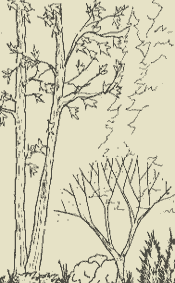
- Mimic natural habitat by planting in layers: tall overstory, small trees, shrub understory, and smaller plants. Layers or other vertical elements (trellis, screen) will help maximize planting area – a useful technique for small spaces.
- Reduce impervious surfaces such as concrete driveways or patios. Impervious surfaces create stormwater runoff (which can negatively impact habitat within the watershed) and act as dead space for wildlife.
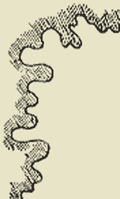
- Maximize diversity by increasing the amount of "edge" between plantings. The "Edge Effect" recognizes that transition areas between habitat types support a greater number and diversity of wildlife. Irregular or curvilinear shaped planting beds will have more "edge" than straight beds.

- Try to create as much diversity as possible. Different wildlife species have varying needs in terms of food, cover and nesting sites. The more diverse your landscape is, the more wildlife you can expect to attract.
- Plant a variety of habitat types: forest, hedgerow, meadow, etc. Where appropriate, create a wet bog or pond by disconnecting your downspouts and directing the water to a low point in your yard (be sure to stay 5-10 feet away from building foundations).
- Design around existing trees or other significant vegetation on your property or surrounding areas. By linking planting areas together, you can create a "habitat corridor" for wildlife to travel through from nearby natural areas.
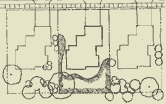
- Lawn is dead space to wildlife. Reduce lawn size and increase planting areas to attract more wildlife. Replant lawn areas with an ecological seed mix or wildflower meadow.
Wildlife-Friendly Fencing
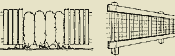
- Fences can be significant barriers to wildlife. Build a semi-solid fence with wire, or leave openings to allow wildlife through. Create a "living fence" with tall shrubs that add privacy without breaking up habitat corridors.
LANDSCAPING TO IMPROVE WATER QUALITY AND RECOVER SALMON
With the loss of several races of salmon and the listing of whole species as endangered, our society is reassessing its landscaping practices. Conventional practices that utilize chemicals, route storm water directly into sewers or streams, and remove bank-stabilizing or other riparian vegetation are being looked at and changed. Programs involved in this effort include the Naturescaping for Clean Rivers program run through the City of Portland and Multnomah County, OR, and similar programs run by the Natural Resources and Parks Division of King County Metro in Seattle, WA.
In general, how we plant and maintain our landscapes affects the water quality and habitat in our rivers and streams. In an effort to improve water quality in our local waterways and to thereby increase our declining fish stocks, the following "salmonscaping" consideration are presented.
- Pesticides and chemical fertilizers are common pollutants in our streams, rivers and lakes. Eliminate their use and recall that native plants thrive without them.
- Turf grass lawns waste water and energy and have little value to wildlife. You can plant an "eco-lawn" that is beautiful, easier to care for, and attracts pollinators such as butterflies.
- Maintain turf height at a higher level, which will create shading to help retain more moisture in the lawn, resulting in less frequent mowing and watering. Switching to manual or electric mowers reduces air pollution as well.
- Stormwater runoff causes sediments and pollutants to collect in our streams. If you live near a stream you can plant trees and other native vegetation that will shade the water for fish, provide food habitat for other wildlife, and help keep our streams healthy by slowing runoff and filtering pollutants.
- Plant drought-resistant native that, once established, require less water because they are adapted to our soils and climate. Water your garden using soaker hoses or drip irrigation early in the morning or at night. Don’t over-water … turf grass requires about 1" or water, or one deep watering, per week in the absence of rain.
- Start a compost pile or recycle your grass clippings and leaves to use as garden mulch. Keep your compost pile away from storm drains, ditches, streams, and wetlands to prevent runoff.